Showing posts with label carry. Show all posts

Tuesday, October 6, 2009

Buy AUDJPY On Dips?

It's very plausible that the RBA (Reserve Bank of Australia) has started the slow process of moving interest rates from emergency levels to normal.

We'll want to see what happens over the next couple of months in order to confirm this analysis. However, from now on whenever the markets are panicked about the latest downward surprise, it might be time to dip your toes in.

We're staring at the bottom of a long term AUDJPY carry trade cycle.

I know that Japan has made some noise about not wanting a weak dollar -- but you have to look at the size of their debt load before you start to worry about them being willing or able to withstand high interest rates.

The recently touted alternate carry trade, consisting of the AUDUSD, is much more precarious in my opinion. It's great in the short term. However, in the longer term, perhaps a year or more, I think you'll find the greenback starts to get supported by higher interest rates. How else will the USA entice foreign entities to continue to buy and hold debt once the worldwide spate of risk aversion fades?

Personally, I think this is a good time to raise capital and slowly work on getting carry trades protected by an in-profit stop loss. Presumably, over the course of months and years, we should find that 80.00 represents resistance, then perhaps 85.00, 90.00, 95.00 or more. We'll probably have Yen intervention from time to time as well and language designed to scare us out... but if you keep an eye on the fundamentals you can probably view these as opportunities to place more capital into stop loss protected profitable trades.

Also, if I was managing a countries financial reserves I think I'd be looking for currency trading opportunities involving countries that are both economically sound and likely to continue to raise interest rates over the years as inflation gathers steam. The general business cycle is probably not going to disappear this time around either... regardless of all the hyperbole in the mainstream media.

Thursday, May 28, 2009

Long Term Carry Trade Fundamentals

While reading a recent CNBC article about current events something clicked for me.

Here is the passage:

The dollar rose broadly on Thursday as yields on 10-year U.S. government bonds jumped more than 50 basis points in the last two weeks, drawing Japanese investors into overseas assets like global semi-conductor stocks, banks and U.S. junk bonds, according to Reuters.
Do you remember the massive unwinds that occurred during the past year? Do you remember all the talk about money heading towards Japan due to risk aversion?

Pay attention, this is significant. It's also backs up my much touted long term notion that carry trade currency pairs are in for a recovery.

Given the quote above what do you think will happen once the jobs numbers start to turn around in the US economy? I'll tell you what I think. I think interest rates and yields will start to rise. What do you think all that money sitting in Japan will do if there is a hot US economy paying good yields? I suspect that it will leave Japan in order to earn good returns.

Guess what that will do to the Yen? That's right, it will drop like a stone. When that happens you'll see carry trading pairs rise massively.

Okay, I realize this may be a year to two away, but as long as we do eventually get a worldwide economic stabilization this is what is in store for us. Anyway, if you are a rookie, be careful, as you can't simply make long term bets willy-nilly. The market can always move against future expectations long enough to blow up your account and it often does so as soon as you throw caution to the wind.

What this means for me is that I may be more willing to accumulate carry trade positions at moments of opportunity. Keep an eye out for fundamentals and watch leading economic indicators such as the Baltic Dry Index or the price of copper.

As you can see these indexes are rising. However, they are still at historically low levels. Are we just in a bounce with respect to worldwide economic activity or are we simply coming up from a recent bottom? You decide.

Forex Tips - Microtrading

The AUDJPY currency pair is currently trading around the 76.00 mark.

Over the last twenty days, from May 7 through May 27, I've been experimenting with a concept I've been calling microtrading.

I don't intend to close all of my positions at the moment, but if I did my account NAV would increase by more than 10% over that period.

While I realize that active trading can return spectacular results compared to a paltry 10% it does require a lot more effort and time. Personally, my full time job and other issues have my complete attention. I don't have the luxury of time or the mindset to take larger risks at the moment.

Anyway, open up your trading platform and I'll walk you through the process of trading this strategy.

1) On May 10 we topped out around 76.00 on the AUDJPY pair.

2) Based on my account size I could safely open long positions for every fall of 20 pips. This isn't the goal but it is the maximum density of trades I'd allow.

3) As the price of this currency pair dropped to around 70.50 on May 15 I would accumulate positions based on the previous point. Basically, when you see what looks like a support point or if the price moved down a lot while you were at work or sleeping, then you open another micro trade.

4) When any one trade has more than 200% profit with respect to margin committed and you believe you are at a resistance point, consider unloading it.

5) Be patient when the market moves sideways. In terms of serious monetary strategies a week or a month is not a long period of time. Keep in mind that you are trading a carry trade pair so you will be paid to wait.

6) I firmly believe that eventually the AUDJPY pair will recover strongly. I'm willing to hold positions for long periods of time as I wait for this. If you don't believe this or you aren't willing to wait, then this strategy may not be useful for you.

Using the above method, with almost zero stress except for impatience during several weeks of sluggish movements, my trading account never committed more than 6% of it's NAV (using 50:1 leverage which is the maximum at my fx broker -- Oanda). However, this morning, as I've stated above, I could close out all my positions at a 10% NAV gain.

This is a simple trading system, though purists may balk at calling it a "system" due to its loose definition. Wait for a drop and buy tiny positions. Capture large profits when they present themselves. Be patient and don't accumulate too large a portion of your NAV. I'd definitely recommend using Oanda due to the ability to trade any size positions and the fact that you can't trade with extreme leverage.

Wednesday, May 6, 2009

Theory: Trading With Little To No Margin

As I often do, especially when the markets are excruciatingly slow in determining when to make the next significant move, I've been thinking about Forex.

Take a mental walk with me...

The DOW falls from 10,000 to 5,0000 and loses 50% of it's value. It returns from 5,000 to 10,000 and gains 100% of it's value.

Wait, think about that for a minute. In the normal world having the ability to gain double digit gains, per year, is considered excellent.

If you are confident that an upward cycle will eventually happen, in a suitable time frame of course, then movement is valuable. If you aren't trading on margin, and you don't have the associated risk, then you can afford to look at each dip in price as an opportunity.

While this may be applicable to the DOW, it is ever more applicable to the Forex markets. If you are trading with little or no margin it's simply a matter of scaling your entry and exit based on price moves. This is very similar to the gridding concept that I posted recently.

However, when the margin is gone the risk is gone. You choose the price range you expect and scale your entry and exit points within it. If you must, you leave some positions in place while you recapitalize to attack another range. In fact, perhaps you simply allocate a set number of dollars per thousand pip trading range. If the price falls into a lower range you simple ante up and play within a lower range -- while your higher range positions provide interest income.

However, keep in mind, it's possible that currency pairs adjust interest rate differential. This could erode or reverse the suitability of holding a pair over a long period of time.

MT4 EA: Average Position Based Trading

While I don't have any pictures to show, yet, I am working on an EA that trades AUDJPY based on the market price relative to the average price of positions held.

The first few passes at this type of system were pitiful. My testing starts from September of last year to now while only opening long positions. As you can imagine this is a difficult period of time for a long only system!

However, late last night I was able to complete a test that showed profits.

The strategy behind this EA is basically as follows:

  • If you've just seen a recent downward movement open an initial position.
  • If the price is high enough above or below your average order open price, open another.
  • If the current price is above your average price close your lowest and most profitable position.
  • Try not to open any position while in a downward movement regardless of the above rules.
Obviously, the last item mentioned is not simple, but it is the key to account survival. If you open too many positions and the market falls too far you will get a margin call.

As ever, I'm basically using the AUDJPY for this. I am interested in strategies that can accumulate a safe quantity of long positions such that they pay me to wait for the eventual upturn.

I'll provide updates once/if I'm able to get appropriate results.

... continuing ...

Here's a chart showing this:


Notice the wicked looking draw down during challenging periods of AUDJPY decline?

Thursday, April 2, 2009

Catching The Run To 71.00

Did you ride the recent run in the AUDJPY to 71?

I was lucky enough to grab and hold a chunk at 65.62 and I'm pondering whether or not I want to let it go.

We've just had a double top on the 15 minute chart. The 1 hour is oversold. I think we are going to get some bounces upward due to exuberance, but it seems about time for a pullback.

I've sold off the nibbles I also acquired on the way up. I think I'll try to sink my chunk. I'd really like to have some sunken carry trade chunks earning interest and I am long term bullish on the AUDJPY.

Be ready for a drop, perhaps today, likely before the weekend.

Monday, October 13, 2008

Market Rationality?

With some major changes happening on a global basis it's just possible that the forex markets will return to rationality.

For example, the Yen crosses (the carry trades) have been taking off like a shot today. I know I've been mooing about a possible bottom here and there in the face of mass panic and extreme volatility as indicated by the VIX.

Was that it?

I hope so, but at the same time there is a lot of economic funk to work through. We've got slowing economies, reduced earnings, ballooned government debt and a whole host of related irregularities.

However, simple economic malaise is not enough to roil the forex markets. They don't have to react in the same way as individual stock markets. If two countries are both going to drop into a recession it would seem that the currencies of those countries would react based on the relative differential between the fundamental shifts in those countries.

I'm not sure if that's clear, but it means that currencies will determine the difference, and change to that -- at least when the markets are rational. It would be great to return to that situation. I'm looking forward to trading in rational markets once again.

They are much easier to trade.

Tuesday, October 7, 2008

Carry Trade Musings

Did you see the carry trades collapse today?

Neither did I.

In fact, things looked downright orderly. Nay, they looked rational. Is this a trick or have all the truly skittish abandon ship at this point?

Be warned, I'm almost always too quick to look past current issues, discounting the ability of the current situation to cause additional convulsions before passing. However, with that said, I'm getting interested in the carry trades.

The AUDJPY, for example, has a lot of retail appeal in Japan. Over time the rate of return during rational market periods is very attractive. There is always a small but consistent upward pressure in this pair.

Both the 1hr and the 3hr charts (Oanda has a 3hr instead of 4hr time frame) could be interpreted as ready for an upward spike. Think I'm nuts? Then get ready for a downward spike.

Just keep in mind that carry trades wind up fairly slowly, most of the time, and unwind with great speed. Your opportunity for quick profit comes with panic and unwinding.

UPDATE: Now, Wednesday morning, we see a recent carry trade meltdown and coordinated rate cuts. Once again I feel compelled to point out that you might just be able to reverse my opinions and be profitable...

Friday, October 3, 2008

Seeing Beyond The Bailout

Now that the US bailout package has been passed the question on everyone's mind is what happens next?

Nobody knows. Conversely, everyone knows!

Once the question of government action has been answered we know that the currency markets will move either up or down. Basically, the only time they are in near stasis is when speculators and investors need the next piece of information in order to properly develop their expectations.

Okay, I know, you'd like some ideas to consider so that you can gather ammunition and make up your own mind.

My take is that the GBPJPY and AUDJPY are setting up for a possible double bottom on their 1d charts. The bailout package represents a reason for currency traders to accept a bit more risk. As I'm sure you know carry trade positions are liquidated during periods of risk aversion. Somebody, somewhere, is going to look at the exchange rates and decide that there are some deals.

I'm unsure which currency is more appealing. Both the UK and Australia appear to be in the process of relaxing fears with respect to inflation. When they drop interest rates their currencies won't react by appreciating in price.

However, the GBPJPY is extremely low in historic terms. Perhaps there is some inertia or general distrust of the cable that needs to be worked out, but you have to wonder how much further it can fall. Isn't somebody out there going to start considering goods and services from the UK competitively priced?

With respect to the AUDJPY, I can't imagine that Australia won't be able to sell commodities into Asia. Sure, currency prices may be falling, but the fall in the Australian dollar will leave exporters in a profitable position regardless. With this being the case -- how can Australia consider inflationary pressures to be abating?

Of course, I should note, speculation on macroeconomic fundamentals such as above is not a short term play.

So, what's my strategy?

I plan to accumulate carry trades during upswings. Sure, what upswings you might be wondering. If there aren't any, then I'll continue to wait. However, I expect to see them soon. Once these trades are profitable I'll place in-profit stop losses on them and open up new positions at opportune moments.

Looking at the long term as I am I see thousands of pips on the table. If I can accumulate more and more positions, under the protection of profitable stop losses, I could end up riding some serious profit. Of course, the hard part is not letting all my trades be shaken off when the market is bucking.

Thursday, September 18, 2008

Forex Market Deconstruction

Now that the trading week is over I thought I'd write about a few things that came to mind over the last couple of days.

Current Situation
Everyone is expecting the Fed to come along and put a multi-hundred billion dollar package together with the help of congress. Obviously, this is relieving a lot of the unprecedented pressure on both stocks and various Forex markets. The only fly in the ointment I'd keep an eye on is whether or not things get delayed for any period of time.

The recent explosion in carry trade prices and equity prices is completely dependent on the confidence that has been brought about by a pending solution. Any risk that the solution won't arrive when promised or that it will take longer than promised could lead to some degree of reversal.

The Mighty VIX
Have you heard various pundits talking about the VIX? Basically, it's a measure of volatility. When prices are jumping around quickly the value of the VIX will be quite high. Anyway, people have been referring to a VIX above 30 indicating some type of volatility threshold that might imply we've bottomed. These high volatility periods represent some level of market emotion, such as panic, after which everyone that wanted to sell has sold.

However, we've hit VIX values that should have represented a reversal multiple times. Is the mighty VIX broken? Why did the bounces at those prices represent false rallies?

The answer is simple really. The VIX levels that traditionally have represented a bottom, or an emotional capitulation in the markets, were previous determined during lesser financial stresses. So, various market players assumed the VIX value meant there was a bottom, but they were working on the assumption that bottoms were decided by a static value.

The VIX value needed to call a bottom is variable. It's relative! The size and scope of the problem combined with the sensitivity (or expecations) of those watching the VIX have to be measured together. The expectation of a simple reversal due to a high VIX thwarted it.

So, in the future, when everyone is looking for a 40 or 50 in the VIX, remember that a lesser disaster may be predicted by a lower VIX value. If you sit around waiting for a super high VIX value you might just be left with a pocket full of cash while the market makes it's big reversal.

Did The Carry Trades Bottom?
It would be very easy to sit back, type out y-e-s, and be done with it. Unfortunately, things are much more complex than that. We're certainly going to have some massive relief and subsequent acceptance of risk. However, a bottom will be determined by whether or not other flare ups start to occur. Are any other countries going to end up searching for that last seat when the music stops?

I hope we saw a bottom. I'm playing it like it's a bottom. I'm convinced it will be a local bottom as long as the Fed's plan is adopted.

Other issues are out there though. Will this represent a turning point for the strength of the US dollar? Will it represent a decline in the Japanese Yen? If so, then what might happen to the NZDUSD or GBPUSD? I don't know how the US economy will react, whether or not they'll print money, or whether or not they'll soon start to increase interest rates. However, I do expect the Yen to decline. It's been driven up a lot, and quickly, by people trying to preserve capital. It will go back down when those people start to worry about missing out on an ability to earn.

Expect a bounce downward. Expect it to happen when you think all is well. Expect it to go far enough to shake your resolve. If you do get dumped, expect it to change direction shortly after... ;)

Market Panic To Market Euphoria?

I'm not certain that euphoria is any wiser than panic, but I do know that the Forex world has changed.

The Fed, Congress and the Senate were meeting earlier this evening and are putting together what is touted to be a comprehensive plan to solve the ongoing financial crisis. Basically, by creating an organization to buy and then auction off troubled assets, the fear and uncertainty in the markets will be abated.

Why? Because pricing information will be visible during the auction process and sales to the Fed will happen from organizations that are not in desperate straights. This puts in a floor and establishes a market.

So, what does this mean with respect to Forex markets? If risk aversion is reduced then you can expect the Japanese Yen to be under pressure. What will that do? It will open up the floodgates to the carry traders.

Guess who's been blogging about accumulating carry trade positions during the recent turmoil?

In any case, you do have to watch out for various risks. The markets will overcompensate. They'll reverse. They'll be disappointed because the solution is not as comprehensive as everyone imagined it would be. Who knows?

Congratulations to everyone that has managed to keep some powder dry... but don't get caught napping, the fire sales will be over just about when everyone wakes up and realizes that there is a fire sale -- or sooner! Just don't load up on too much of anything, because somehow the market gremlins are always watching for this situation and they have ways of punishing the unwary.

Tuesday, September 16, 2008

Long Term Carry Trade Prognosis

With the temporary loan facility made available to AIG by the Fed it seems that the currency markets are getting back a bit more appetite for risk.

The Yen has been dropping and carry trade pairs have floated erratically to more respectable levels. The real question is how the US markets will react tomorrow. I'm expecting the equity markets, the DOW, to do well but I don't know if the carry trades will look appetizing.

If you've been following along you'll know that I put a grid of limit buy orders above the falling prices during the recent crisis. Many of these were struck today shortly after the AIG bailout was announced... allowing me to avoid risk on the way down and letting me catch the upturn without having to be married to my trading platform.

Since I'm feeling smart, which means I'm likely to put in my foot in my mouth at any time, I'll talk about my current thoughts. I am expecting that Asia, most notably China, will be resistant to economic downturn. This will allow countries in the region, again most notably Australia and New Zealand, to grow exports whether or not US and European markets have slowed -- especially since China is very hungry for commodities.

The long term effect of this on Forex markets is that the interest rates in those countries would fall much less than expected or be increased much sooner than expected. Japan, on the other hand, is not known for it's ability to provide commodities. It may find itself more tied to the fates of the US and European markets. If so, and if those areas do drag down the Japanese economy, then the carry trades will be hot properties.

This means that it's time to keep an eye out for long term bottoming activities in the JPY crosses. It might take six days, six months or several years, but keep an eye on economic activity in commodity rich countries. This will give you an early clue as to whether or not this is going to occur. Alternately, keep on eye on the US, because if that economy doesn't implode, everyone running for cover is certainly in the wrong.

Anyhow, since I'm the business of speculating, I guess it doesn't hurt to speculate, does it?

Wednesday, September 10, 2008

Forex Carry Trade Bottom?

I'm probably never going to try to call a bottom, but I will point out that there is a difference in behavior since the recent panic drop. Now, we see the Yen based carry pairs bouncing off a resistance point instead of simply dropping as if they are in free-fall.

What am I doing about it?

I'm glad you asked. My current trading activity involves playing with a bit of a gridding strategy. When the price gets down near the recent resistance point I'll place limit buy orders above the price. This means that if the price rises I'll start filling orders. These orders have a small take profit zone so I won't have to worry about accumulating many positions, or risk, but I'll make an okay profit if the price decides to bounce back and forth for a while.

I've booked small amounts of incremental profit this evening in the EURJPY, GBPJPY and AUDJPY markets. Admittedly, the profit is very small per trade. However, if the price continues to rise and fall I'll be able to take that same small slice of profit during each cycle. It adds up!

Interestingly, if the price drops, I'll just extend my grids downward and catch whatever eventual upturn arises.

Don't forget, I like to accumulate long-term carry trade positions at what are apparent low points. I make sure not to overextend my account so that the sum of my open positions are not large enough to put my account at risk. So, if I end up holding on to some grid based trades for the longer term, I am fine with that.

Saturday, September 6, 2008

Carry Trade Panic Selling?

Did anyone notice the panic selling out there?

All kinds of carry trades unwound several hundred points in a very short period of time. Speculation in the Forex news rags suggests that losses due to the falling stock exchanges forced people to unwind their carry trades to cover their margins.

In any case, after days of regimented downward movement, the sudden fallout represented a panic moment -- for someone. In the short term, at the very least, this should represent opportunity. I've stuck my toe in.

I certainly don't know if it represents a bottom, but if everyone that wanted out got out, then it won't have much pressure to fall further.

Personally, I'm looking at the Yen based carry trades. Things like the EURJPY, GBPJPY, and the AUDJPY. While the US may eventually recover and raise interest rates, I don't see the Japanese being able to raise interest rates while their currency is appreciating.

How in the world would they compete internationally, exporting products, if they drove their prices up now when everyone else looks to be faltering already?

Have I mentioned lately how important it is to have money on the sidelines so that you can take a poke at raging opportunities? Whether or not you are a fan of his, Jim Cramer also is a proponent of not being fully invested -- which he states is a common joe public trader type of mistake.

Big opportunities offer big profits, but only if the opportunity didn't break you as it was developing.

Monday, September 1, 2008

Carry Trade Accumulation Strategy

As I haven't seen this forex tactic expressed anywhere else I thought I'd blog about it and share it with my small readership.

Are you familiar with trailing stops?

This is when you set a stop loss some number of points below the current price and then allow that stop loss to float when the price moves in a profitable direction.

Well, I'm not going to talk about stop losses, but the idea is similar. What I'm going to describe is a trailing limit order.

Let's say, for example, that you think the GBPJPY is starting to look like a good deal. Instead of jumping on and buying it you may want to set a limit purchase order above the current price. The odds are good, given recent history, that the price will drop further.

Bingo. You can then adjust your limit order and trail the market price by some appropriate level. Be warned that the price could spike, activating your purchase, and then continue dropping. In today's environment you can then save yourself the risk of acquiring a position until the price does show some type of strength.

I'm not aware of any forex trading platform implementing this so you'll have to execute a manual trailing limit order yourself.

Sunday, August 31, 2008

Carry Trading Thoughts

Today's post is basically a bit of mental exercise concerning accumulating carry trades. If you are looking for serious advice, this post probably isn't it.

Anyway, for the two or three people that do follow along, you know that I like carry trading. For today's exercise, let's consider the GBPJPY. Looking at the five year chart on Google finance we can see an absolute range of approximately 7000 pips. The GBPJPY price went from somewhere near 180.00 all the way up to 250.00 at it's high.

That's a lot of pips!

Looking closer, we can see that from the highs last summer we have retraced almost 5000 pips.

Now, I know that there is a lot of turmoil in US, UK and world markets, but I don't forsee the GBP being wiped out any time soon. I'd like to accumulate GBP but I don't want to simply buy it on the way down as I have no idea how far down the currency might travel before finally deciding to fight back.

Let's think. How can I take advantage of another future uptrend without risking a lot of capital before it happens? How can I take serious advantage of such a future uptrend if I don't currently have much capital myself? Obviously, I need to find a way to minimize my risk and take advantage of a future trend with house money.

What if I execute some type of sneaky manual gridding strategy. I'm going to design this so that I never have much actual capital at risk while not have to sit on the sidelines if things go my way. Curious? So am I, as I haven't worked through the details yet myself.

Since I trade with Oanda let's consider some very low capital trading. We'll create limit orders above the current market value. These can only be tripped if the market moves up. Given the current bid price of about 198.20 let's consider the following order list...

- buy 10 at 198.30
- buy 10 at 198.35
- buy 10 at 198.40
- buy 10 at 198.45
- buy 10 at 198.50
- buy 10 at 198.55
- buy 10 at 198.60
- buy 10 at 198.65
- buy 10 at 198.70
- buy 10 at 198.75

There, that's ten trades. We'll have a total of 100 units of GBPJPY if the pair moves up to 198.75 at some point. I know this isn't very impressive. I also know that the price is likely to drop too -- it never moves in a straight line. So how do we handle these issues?

First, let's realize that you'd have to have a tiny account to worry about any size of price move while holding onto a mere 100 or 200 units of currency. So, having this level of capital at risk is not a problem. Hey, don't laugh, we aren't done yet!

To keep our risk limited, let's set a stop loss on our lowest priced trades. We'll set it 11 pips above our purchase price and leave only 100 units of currency at risk at any point in time. At 11 pips we'll grab a penny per stop loss tripped potentially see 9 positions left underwater. Keep in mind that over time we could leave multiple sets of 9 positions underwater whenever the price rises for a while prior to the GBPJPY hitting what will become a regional low.

Thinking out loud some more, if we leave 10 underwater sets above us on the way down we'll be sitting on approximately 1000 units. Let's say they average 5000 pips underwater -- which leaves a LOT of room for continued deterioration. We'd be looking at a capital drawdown of less than 500 dollars. At the same time, this is a carry pair, so we would be earning some offsetting interest during this period of being underwater.

Okay, so I am probably looking at a fairly safe idea. I don't expect another 5000 pips of descent, but it's also possible that I can leave more than 1000 units underwater if prices start to whipsaw. I'm comfortable. Now, am I interested? Let's take a look at the behavior on the way up.

Here's an aggregate accumulation of positions during an uptrend...

198.30 - 199.25 ... 200 units
199.30 - 200.25 ... 200 units
200.30 - 201.25 ... 200 units
201.30 - 202.25 ... 200 units
202.30 - 203.25 ... 200 units

Hmm, this doesn't seem to be a large enough accumulation to really sink my teeth into an uptrend. Can I fix it? Maybe. What if we execute trades with larger and larger sizes? Is this somewhat reminiscent of a Martingale strategy?

buy 10 at 198.30
buy 11 at 198.35
buy 12 at 198.40
buy 13 at 198.45
buy 14 at 198.50
buy 15 at 198.55
buy 16 at 198.60
buy 17 at 198.65
buy 18 at 198.70
buy 19 at 198.75
buy 20 at 198.80
buy 22 at 198.85
buy 24 at 198.90
buy 26 at 198.95
buy 28 at 199.00
buy 30 at 199.05
buy 33 at 199.10
buy 36 at 199.15
buy 39 at 199.20
buy 42 at 199.25

Well, this certainly grows a lot faster. We would have 435 units open after about 100 pips of movement. This is going to increase our risk quite a bit. There is always a tradeoff. You simply cannot increase rewards without increasing risks. While I'm not going to do a lengthy detailed analysis of varying rates of growing trade sizes, you can certainly see that our larger riskier trades happen at higher and higher prices. That doesn't feel right.

Another way to look at this is that the probability of making a losing trade increases as the price rises. Eventually the price of the currency pair will hit a regional top and any trades made near that point must be losers. Let's look for a strategy that doesn't require increasing risk with increasing prices. I still want to make a future GBPJPY recovery work for me!

What if I'm willing to add additional funds to my account? I generally have no problem putting about 10% of my net asset value into active carry trades. It would take a tremendous move to cause a margin call if you only use a small amount at any point in time. With a $450 capital infusion I'd be willing to use $45 of margin. Let's see a grid based on getting this money into the market.

- buy 125 at 198.30
- buy 125 at 198.40
- buy 125 at 198.50
- buy 125 at 198.60
- buy 125 at 198.70
- buy 125 at 198.80
- buy 125 at 198.90
- buy 125 at 199.00
- buy 125 at 199.10
- buy 125 at 199.20

Okay, we get 1250 pips out of a 100 point move. If the market doesn't go up then our grid will adjust and move downward. If the grid is activated but then the market immediately drops we have sunk our cash infusion into a reasonable carry trade. Assuming another cash infusion in the following month we can continue to lay out upward grids above the current price.

By putting in fresh capital, and expecting further fresh capital, we can get comfortable pushing our capital into positions at a relatively rapid pace. What happens if the market starts to follow an overall upward trend? Following along from where the grid above left off we get...

- buy 125 at 199.30; place stop loss at 198.40 for our trade at 198.30
- buy 125 at 199.40; place stop loss at 198.50 for our trade at 198.40
- buy 125 at 199.50; place stop loss at 198.60 for our trade at 198.50

Okay, our overall risk isn't increasing. Each time we open a new trade we protect the capital behind the trade which is currently most profitable. We are accumulating more and more open positions without increasing trade size.

However, there is every possibility that it may takes months of capital infusions and a fairly sizable carry trade position before the market turns around to any degree. What if it takes years before the GBPJPY makes any attempt at serious recovery?

Anyway, as I said at the beginning, this is just a mental exercise. I don't think that very many people trade with a carry accumulation mindset. I suspect that many traders are looking at the swings in price and trying to get in on them... as they are huge in magnitude compared to shaving some interest from the market over larger time periods.

I've had some luck trading price movements myself... but I like the lure of building up some type of income stream over time.

Saturday, August 30, 2008

Forex Turmoil: Still On The Sidelines

During the last few weeks of topsy-turvy price movements I've been playing it safe. I like to buy carry trade pairs, but they've been heading down a lot.

Now, the big question, when will things start to turn around? A few of the pairs are getting into historically low valuations. For example, take a look at the GBPJPY pair on google finance -- click the 5yr option when it loads.

Sure, we could set new lows, perhaps for a months or years, but the odds of the UK having lower interests rates than Japan seems rather extreme. At some point, when things do finally settle down in another year or more, the GBPJPY will start to get attractive.

Other pairs, such as GBPUSD or EURUSD, which represent a bet against the US dollar make me nervous. While there is a possibility that some parts of the world, notably Australia, New Zealand and Asia, can avoid a recessionary period it's also very possible that the sinking US dollar will create a large enough trade advantage to shift the slowdown from the US to other countries as their own companies find it harder to compete internationally.

Anyway, I don't know how it will play out and from what I've learned buying a currency without having a clear notion of what you expect to happen is akin to gambling. Sure, you can be wrong when you believe something, but at least then you aren't throwing your money at the toss of the dice... and often it is possible to figure out what is going on to some degree.

So, for now, I'm keeping an eye on the JPY crosses. Perhaps the AUDJPY, EURJPY, GBPJPY and CADJPY will find themselves showing up in my account?

Saturday, April 12, 2008

Trading The EUR/AUD

I've spent the better part of a year focusing my attention on the AUD/JPY. I think it's time to start looking into other pairs...

Last week I started trading (shorting) the EURAUD.

The EURAUD is another pair suitable for the carry trade. [For you beginners, some currency pairs earn interest while you hold them. Those that do allow you to participate in the so-called carry trade. See my recent forex roadmap post for a nice list.] However, I've been trading it instead of trying to hold onto it... and so far it's been good to me.

The question is, what will next week bring?

I haven't focused on active day trading before. I've got a chunk of carry trade holdings across a variety of currencies, but that is a completely different game. Basically, as long as you don't overtrade [buy too much and hence expose yourself to excessive risk] it's very slow paced. When you have some extra capital in your account look for an opportunistic pricing situation and grab a small slice of a pair you are willing to hang on to.

Active trading is a lot faster paced. I'm finding that if I want to spend a lot of time on the market I need to be have the lure of gains. Yes, that means risk! So, I've created a sub-account where I put a few dollars at extreme risk. Assuming I can make some wins I'll shuttle those wins to a safer sub-account.

So, I'm no longer executing a purely boring long-term carry strategy. Seriously, it's very boring to put a few bucks into your account from time to time and then make a purchase once in a blue moon when your capital reserve makes it safe to do so. I want to do this, but I also need to drive the Ferrari once in a while, y'know?

Yep, shorting the EURAUD is my currency trading Ferrari. It seems to sidestep the volatility of the AUDJPY somewhat by avoiding the EURUSD and USDJPY influences. It handles well since the EUR is such a huge and active market and acquires some nimble moves from the AUD.

Thursday, January 31, 2008

Kramer's Bottom Call

I take heart in the fact that Kramer has called a bottom.

Although there is a lot of volatility I am hoping that over time I'll be able to build and protect a sizable AUDJPY position. You see, as you get positions in profit and place stop losses in to protect them, you get to start again with respect to risk. Also, as the profits rise, you can start to get positions that are funded by locked in profits instead of your own capital.

Finding a bottom, then sinking in some serious capital, will let you earn a decent incremental revenue without much effort... at least until some large downturn starts to remove you from the market.

At that time, assuming you've moved the stops up a little, you'll end up with some nice gains to your capital to offset the loss of income.

I guess there is always the chance that interest rates will change, but until then, this is my long term goal.

I only hope Kramer is right. If we've hit bottom, then it will be "easy" to buy into uptrend days... over and over again.

Wednesday, January 16, 2008

Fundamental Forex Guesswork

Okay, so during the NY trading session today I did manage to get some AUDJPY positions protected under a stop loss.

What I'm hoping, and I'll try to convince myself via fundamental issues, is that the foreign markets will rise based on US news. You see, the US economy came out luke warm today. Inflation didn't seem to be a big issue and various sectors were weak, but nothing was catastrophic.

This means that the Fed will apparently have no trouble lowering interest rates going forward.

So, we have competing issues. On one side we have a non-terminal US economy even though the US appears in the throes of a mild recession. On the other side we have the potential for a weaker US dollar because of expected interest rate cuts.

Anyway, as I said above, given the non-news out today, the world economy hopefully won't be seen to be mid-flush as of yet. This should let other markets take a small ride and possibly allow me to accumulate a few more protected positions.

As always, the alternate is that my stops are hit and I simply wait for a chance at an upward trend on another day.

UPDATE:

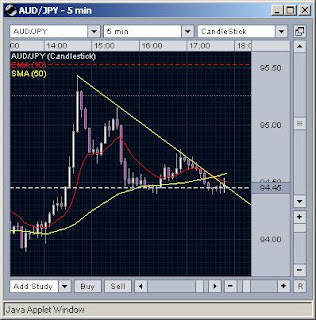
I was frustrated to see that the double spike near the end of the trading day turned into a trend line. There didn't seem to be any good reason but I guess there never is. We'll see if that line will break. If it does, I'm expecting some upward movement from the break point.

Surprising Down Trend