I don't have time to snip a chart or anything, however I'd suggest taking a few moments to analyze the AUDJPY.
What I see is the potential for a so-called "big W" on the 3 hour chart. You'll notice the right side of the W has a double bottom. If we do get the full "big W" we should see some dramatic upward movement over the week.
Fundamentally, inflation, employment and other indicators in Australia seem to indicate the need for the RBA to continue to increase rates. If any more hot growth news comes out prior to February we may see speculation on a 50 basis point increase instead of the widely expected 25 basis points.
In summary, look for a safe low-risk entry point if your analysis of the charts agrees (or even disagrees) with mine.
UPDATE: If you disagreed with me you'd be happy with this morning's (Jan 20) breakdown... though so far the next resistance point seems to have held.
Tuesday, January 19, 2010
AUDJPY: Poised?

Wednesday, October 7, 2009
Beating The AUD Drum
Did anyone notice this AUD tidbit?
Unemployment fell to 5.7% from 6.0% against expectations of no change. The extremely strong job number will cement expectations that the RBA will continue to hike rates and perhaps be more aggressive in doing so.If you been following my blog this isn't going to be a surprise.
As my last post said... buy on dips.
Tuesday, October 6, 2009
Buy AUDJPY On Dips?
It's very plausible that the RBA (Reserve Bank of Australia) has started the slow process of moving interest rates from emergency levels to normal.
We'll want to see what happens over the next couple of months in order to confirm this analysis. However, from now on whenever the markets are panicked about the latest downward surprise, it might be time to dip your toes in.We're staring at the bottom of a long term AUDJPY carry trade cycle.
I know that Japan has made some noise about not wanting a weak dollar -- but you have to look at the size of their debt load before you start to worry about them being willing or able to withstand high interest rates.
The recently touted alternate carry trade, consisting of the AUDUSD, is much more precarious in my opinion. It's great in the short term. However, in the longer term, perhaps a year or more, I think you'll find the greenback starts to get supported by higher interest rates. How else will the USA entice foreign entities to continue to buy and hold debt once the worldwide spate of risk aversion fades?
Personally, I think this is a good time to raise capital and slowly work on getting carry trades protected by an in-profit stop loss. Presumably, over the course of months and years, we should find that 80.00 represents resistance, then perhaps 85.00, 90.00, 95.00 or more. We'll probably have Yen intervention from time to time as well and language designed to scare us out... but if you keep an eye on the fundamentals you can probably view these as opportunities to place more capital into stop loss protected profitable trades.
Also, if I was managing a countries financial reserves I think I'd be looking for currency trading opportunities involving countries that are both economically sound and likely to continue to raise interest rates over the years as inflation gathers steam. The general business cycle is probably not going to disappear this time around either... regardless of all the hyperbole in the mainstream media.
US Economy Heads Up
If you are wondering what is going on with the US economy, this puzzle piece from CNBC will fit in very nicely.
What this is saying is that there probably is not a small business collapse in the works due to credit issues. Smaller businesses will simply wait until they see consumer spending before they bother to access credit.Personally, I am going to suggest that old habits die hard. For all those that did not suffer unemployment, which will be the majority of consumers, the lure of credit and consumption will be waiting for them once confidence returns. As well, they will have fattened their bank accounts to the point that they won't know how to resist putting some of it to use.
While we do perhaps have a lot of reasons to fear gloom and doom, we also have a consumer tinderbox waiting for a spark. I don't know which one will win out nor do I know how long it will do so. For example, I don't know if the tinderbox can be lit before housing prices start to rise. What is the ratio of renters vs owners?
I do know that the nuggets of information regarding real people, real habits, and their likely actions are few and far between. Too much of the material we read (on CNBC) is very biased by political viewpoints... and you need to find a way to see past that barrier to the good information the partisan baloney conceals.
UPDATE: Wednesday 7-Oct-2009
As a counterpoint, here is another article talking about problems caused by the ongoing lack of various debt-securitization markets.However, I will point out that the title seems a bit broad for the issue at hand. It seems that the article is pointing to the idea of a systemic inability for large lenders to resell their lending in order to enable more lending.
Perhaps the fact that these institutions, and their rating agency cohorts, have just burned half the planet with their prior recklessness is one reason that purchasers of these products are a bit gun shy?
Monday, October 5, 2009
Robot Strategy / Development
Without getting into detailed specifics I thought I'd try to answer a recent question about the strategies I'm trying with my various robots.
First, a bit of background in case this is the first post you see on this blog:
- I design software and systems for a living
- I've been trading for years -- learning through the heart of the downturn.
You may also want to consider the fact that the Australian economy seems to be doing very well with respect to the rest of the world. I've been pointing that out on my blog from time to time. Also, if you follow AUDJPY as I do, you may notice that the RBA just hiked interest rates by 25 basis points. This bears out a previous post about the long term carry trade prognosis dated September 2008.
Anyway, what this all means is that I'm happy to open long positions in AUDJPY, to some pre-defined level of risk, and then wait for this currency pair to give me some profits. To get down to brass tacks, the AUDJPY trading robot looks for what appears to be decent entry points, perhaps via stochastics and/or moving average crossovers, and then opens up micro-positions.
Sure, often the robot is wrong for some period of time. Who cares? With confidence that the AUDJPY will eventually rebound, and/or pay decent carry trade rates, it doesn't hurt to wait. Besides, when the robot is wrong, trades entered at even lower levels can often be closed for a profit, repeatedly, prior to a later price rise allowing the short-term carry trade to be closed for a profit.
In case you are thinking this sounds like throwing darts here are a few of the strategic points that guide this strategy:
- The fundamentals over the next period of years points to a rising AUDJPY.
- A future period of panic is unlikely to exceed the unwind that occurred during the recent financial crisis.
- A rising AUDJPY will eventually allow any position to be exited profitably during a new high.
- Using microtrades allows frequent trading within precise levels of accumulated risk.
- Adding logic to enter positions at what will often be an opportune time greatly improves the odds of taking profit from a position quickly.
The reason this is interesting is that you can define the rate of return you want. Trade N positions at size S per hour at P pips profit and you will earn $D. Of course, it isn't so simple, but that's where the challenge lies. How do you keep from accumulating all your long positions at a recent top and all your short positions at a recent bottom? How do you keep from accumulating positions during a lull in price movement? How can you goose profits during active periods to make up for price movement lulls?
This thing is a work in progress, is not significantly capitalized, and probably is a pure dart throwing exercise. However, it does keep me busy. This is important. If I don't keep busy I'll worry too much about what's happening in my AUDJPY sub-account and either make discretionary trades or tinker with something that is already working well enough.
Anyway, all strategies face the same basic issues. These include:
- Prices will eventually move up and down in varying amounts.
- Accumulation of positions incurs increasing levels of risk.
- Avoidance of risk decreases maximum theoretical gains.
- Carry trades have long term pressure supporting the carry trade.
- Carry trade pairs have periodic unwinds.
- Long term economic fundamentals are plainly visible to all but very often misunderstood.
In a nutshell -- my current robot strategy is to look for long term predictability and then try to take advantage of that predictability as often as possible using small individual units of risk.
A final word of advice. If I'm wrong about the AUDJPY, and it doesn't have a long term rising trajectory, then I'll have an unproductive robot sitting on some carry trades. Similarly, if you decide to take advantage of a longer term trend, make sure you have a solid basis for your predictions.
Saturday, October 3, 2009
AUDJPY Roller Coaster
Generally, I follow and prefer to trade the AUDJPY. It goes through unwinds from time to time as the bigger players suffer fits of risk aversion.
For the last few weeks we've been bouncing back and forth between 77 and 80. On the way down, with all the gloom and doom blaring in the media, it feels like we must be about to fall off a cliff.
It's difficult not to be scared. After all, anyone who was trading during the last couple years knows very well what it feels like to fall off a cliff. Ouch.
However, it's precisely when everyone is scared that prices adjust too much. How do you know when to get in without trying to pick the bottom? You get in when you have a strong resistance point. You can enter your trade, conditions permitting, and set your stop at a safe distance below the resistance point. You get in when you know there is a large potential upside and a low potential downside.
With all my work on robots I haven't been doing much discretionary trading lately. In a strange way, this is helping me develop patience.
My personal take is that we're going to have variability in the global economic recovery. Some portions of the world will contract while others expand, and then we'll probably get oscillations between those regions. This means that the roller coaster may be the main mode of the markets until everyone starts to settle down and stop pressing the panic button. This could take a very long time.
However, this is great news!
The roller coaster is a great place to trade. As long as you are only trading appropriate amounts of capital per position you have the ability to earn every time we get another cycle of exuberance and fear.
As long as we have people in both camps, gloom and doom vs surprising growth and strength, then the markets will be a great place to be. Just keep an eye out for anything that truly is a disaster in waiting.
In particular, I think we are at a point where different segments of the trading world exhibit different behavior. For example, Australia and Japan exist in a different economic climate than the USA. It's quite possible that traders in these regions, especially those not too tied to US events, won't be feeling risk aversion.
Similarly, sections of Europe seem to be recovering nicely. I can see that many regional traders would not be overly risk averse, in general, and that carry trade strategies might be entertained. For example, China and India are becoming more important in terms of world trade and they don't seem to be necessarily synchronized with the US.
This is another reason for our roller coaster. We may get different directions on the risk trades (carry trades) based on which financial center is generating most of the trading activity. Yet another reason to expect a choppy ride.
Related reading... yahoo finance.
Thursday, May 28, 2009
Long Term Carry Trade Fundamentals
While reading a recent CNBC article about current events something clicked for me.
Here is the passage:
The dollar rose broadly on Thursday as yields on 10-year U.S. government bonds jumped more than 50 basis points in the last two weeks, drawing Japanese investors into overseas assets like global semi-conductor stocks, banks and U.S. junk bonds, according to Reuters.Do you remember the massive unwinds that occurred during the past year? Do you remember all the talk about money heading towards Japan due to risk aversion?
Pay attention, this is significant. It's also backs up my much touted long term notion that carry trade currency pairs are in for a recovery.
Given the quote above what do you think will happen once the jobs numbers start to turn around in the US economy? I'll tell you what I think. I think interest rates and yields will start to rise. What do you think all that money sitting in Japan will do if there is a hot US economy paying good yields? I suspect that it will leave Japan in order to earn good returns.
Guess what that will do to the Yen? That's right, it will drop like a stone. When that happens you'll see carry trading pairs rise massively.
Okay, I realize this may be a year to two away, but as long as we do eventually get a worldwide economic stabilization this is what is in store for us. Anyway, if you are a rookie, be careful, as you can't simply make long term bets willy-nilly. The market can always move against future expectations long enough to blow up your account and it often does so as soon as you throw caution to the wind.
What this means for me is that I may be more willing to accumulate carry trade positions at moments of opportunity. Keep an eye out for fundamentals and watch leading economic indicators such as the Baltic Dry Index or the price of copper.
As you can see these indexes are rising. However, they are still at historically low levels. Are we just in a bounce with respect to worldwide economic activity or are we simply coming up from a recent bottom? You decide.
Tuesday, May 26, 2009
FX Trading And Analysis
I've become a little frustrated with most of news sources out there. If you've been an active forex trader for any length of time you'll notice that talking heads are always trying to tell you why something happened.
That's really nice, and might possibly help you learn about various financial interactions, but it's absolutely useless from a trading point of view. If you are trading you need to figure out what's going to happen -- not what just happened. Check out this video (complete with atrociously low audio levels).
This type of analysis is unlikely to help you with your fx trading tomorrow. Generally, how the markets will move tomorrow, based on tomorrow's news, is not something you'll get from any of the gurus and talking heads.
On the other hand useful analysis will be too slow to be meaningful. For example, I'm very confident the world economy will eventually recover. When that happens we'll have a period of high interest rates as rising commodity prices drive inflation. Guess what? This will mean that carry trades pairs will end up at much higher prices. Unfortunately, I can't tell you when the world is going to focus on this. Generally, not before the money moves from wherever it is to wherever it is finally going to end up.
The closest thing to predictive analysis, or something you can really use to drive your forex trades, is technical analysis. Charting. Something which gets very little respect in some circles. Many people don't understand it and many others discount it because it isn't able to make perfectly accurate predictions. Technical analysis does not have to be a perfect tool for prediction. It merely has to increase the odds that your fx positions end up earning you a profit.
Thursday, January 8, 2009
Fundamental Conjecture
Something to keep in mind when you consider where the currency markets will be heading in 2009.
It appears that the Obama stimulus package will contain a $250,000 write off for business expenses. This is huge. Smaller businesses, when generating expenses, are not generally spending their money outside of the US. Vehicles, machinery, tools, raw goods or whatever else is eligible for this tax change will quickly represent income to other domestic businesses.
This is big.
Additionally, it was just reported today that mortgages on primary residences will soon be allowed to be adjusted during bankruptcy. According to some pundits this is a very large win as it is actually supposed to be better for the banks -- compared to a foreclosure. Not to mention the fact that if this done, greatly reducing foreclosure events, the downward pressure on housing prices will be released.
This is also big.
Finally, though it sounds like an insignificant item, Obama mentioned the need to restore trust in the financial system. Perhaps you are not aware, but the only thing that allows people to trade and exchange money via markets is trust. If you don't trust that you'll get a fair trade, receive ownership, or be protected to some degree from swindles and excess, then why in the heck would you put your money at risk?
This is perhaps the biggest item. However, don't be surprised if this item turns into political fodder as ideologues argue against it. What these ideologues often forget is that free markets simply require a level and trusted playing field. Rules are fine -- as long as they're enforced reliably for all players.
Don't forget that!
Saturday, October 18, 2008
Fundamental Market Conjecture
Be warned that for some reason I remain a perennial optimist.
It strikes me that a lot of the current analysis is based on credit spreads and other esoteric measurements with an eye towards what current values would have implied during past periods.
I'm not saying that this analysis of fundamentals is wrong, but consider this for a moment. Every time something surprising happens we end up looking backwards and seeing an obvious exception to rules that everybody had been following.
If you don't know what I'm talking about think back to the great depression. It taught us that the government should not greatly restrict money and spending during tough times -- or else. That event greatly advanced our thinking and until recently we had constraints on capitalism in order to protect ourselves.
So, what, if any, shaky assumptions are we all basing our fundamental analysis on?
I wish I had some concrete ideas.
What about adopting the T. Boone Pickens plan? Pushing that amount of money into natural gas, and the companies and employees that would produce it, would be a tremendous economic stimulus. Think about it. Instead of throwing money into the ocean to pay for foreign oil the US would be paying it's own citizens to produce energy resources. Those citizens would get off of the unemployment roles, spend their money on goods and services and even pay taxes.
The analysis on moving from oil to alternatives has not taken into account the tremendous effects of the velocity of locally spent money.
Hey, what about winding down war time spending and bringing home the majority of the US troops abroad? Once again, all of the consumable products and services being purchased from foreign suppliers could be eliminated. In short, it's another way to stop throwing money around the world and stoke the internal flames of the US economy.
Does anybody know if China is still on the map? I can't believe that all the people in China will suddenly stop consuming good and services. Who are they going to buy their commodities from? Just as the parabolic spike to high prices was a gross mistake, so is any reverse parabolic spike to prices well below the bottom of the last parabolic rise.
Perhaps over the centuries we've developed a little bit more investor intelligence? I know, I know, this is hard to believe under the current meltdown, but there are people out there with untold amounts of capital under their management. They are going to be spotting bargains very soon now -- and they can step in and properly capitalize companies that have excellent long term value if the current owners find themselves in a position that forces them to sell.
I don't know what will or won't happen. However, I do know that having a global credit crisis right before an expected global economic slowdown has driven panic to levels that are perhaps unheard of. This implies that market mood will be driven down to lower levels than would be appropriate for either crisis alone. At the same time, many companies that refuse to or are unable to get capital are going to find themselves facing pent up demand -- assuming the end of the world does not quickly ensue.
Maybe.
Friday, October 3, 2008
Seeing Beyond The Bailout
Now that the US bailout package has been passed the question on everyone's mind is what happens next?
Nobody knows. Conversely, everyone knows!
Once the question of government action has been answered we know that the currency markets will move either up or down. Basically, the only time they are in near stasis is when speculators and investors need the next piece of information in order to properly develop their expectations.
Okay, I know, you'd like some ideas to consider so that you can gather ammunition and make up your own mind.
My take is that the GBPJPY and AUDJPY are setting up for a possible double bottom on their 1d charts. The bailout package represents a reason for currency traders to accept a bit more risk. As I'm sure you know carry trade positions are liquidated during periods of risk aversion. Somebody, somewhere, is going to look at the exchange rates and decide that there are some deals.
I'm unsure which currency is more appealing. Both the UK and Australia appear to be in the process of relaxing fears with respect to inflation. When they drop interest rates their currencies won't react by appreciating in price.
However, the GBPJPY is extremely low in historic terms. Perhaps there is some inertia or general distrust of the cable that needs to be worked out, but you have to wonder how much further it can fall. Isn't somebody out there going to start considering goods and services from the UK competitively priced?
With respect to the AUDJPY, I can't imagine that Australia won't be able to sell commodities into Asia. Sure, currency prices may be falling, but the fall in the Australian dollar will leave exporters in a profitable position regardless. With this being the case -- how can Australia consider inflationary pressures to be abating?
Of course, I should note, speculation on macroeconomic fundamentals such as above is not a short term play.
So, what's my strategy?
I plan to accumulate carry trades during upswings. Sure, what upswings you might be wondering. If there aren't any, then I'll continue to wait. However, I expect to see them soon. Once these trades are profitable I'll place in-profit stop losses on them and open up new positions at opportune moments.
Looking at the long term as I am I see thousands of pips on the table. If I can accumulate more and more positions, under the protection of profitable stop losses, I could end up riding some serious profit. Of course, the hard part is not letting all my trades be shaken off when the market is bucking.
Tuesday, September 16, 2008
Long Term Carry Trade Prognosis
With the temporary loan facility made available to AIG by the Fed it seems that the currency markets are getting back a bit more appetite for risk.
The Yen has been dropping and carry trade pairs have floated erratically to more respectable levels. The real question is how the US markets will react tomorrow. I'm expecting the equity markets, the DOW, to do well but I don't know if the carry trades will look appetizing.
If you've been following along you'll know that I put a grid of limit buy orders above the falling prices during the recent crisis. Many of these were struck today shortly after the AIG bailout was announced... allowing me to avoid risk on the way down and letting me catch the upturn without having to be married to my trading platform.
Since I'm feeling smart, which means I'm likely to put in my foot in my mouth at any time, I'll talk about my current thoughts. I am expecting that Asia, most notably China, will be resistant to economic downturn. This will allow countries in the region, again most notably Australia and New Zealand, to grow exports whether or not US and European markets have slowed -- especially since China is very hungry for commodities.
The long term effect of this on Forex markets is that the interest rates in those countries would fall much less than expected or be increased much sooner than expected. Japan, on the other hand, is not known for it's ability to provide commodities. It may find itself more tied to the fates of the US and European markets. If so, and if those areas do drag down the Japanese economy, then the carry trades will be hot properties.
This means that it's time to keep an eye out for long term bottoming activities in the JPY crosses. It might take six days, six months or several years, but keep an eye on economic activity in commodity rich countries. This will give you an early clue as to whether or not this is going to occur. Alternately, keep on eye on the US, because if that economy doesn't implode, everyone running for cover is certainly in the wrong.
Anyhow, since I'm the business of speculating, I guess it doesn't hurt to speculate, does it?
Saturday, August 30, 2008
Forex Turmoil: Still On The Sidelines
During the last few weeks of topsy-turvy price movements I've been playing it safe. I like to buy carry trade pairs, but they've been heading down a lot.
Now, the big question, when will things start to turn around? A few of the pairs are getting into historically low valuations. For example, take a look at the GBPJPY pair on google finance -- click the 5yr option when it loads.
Sure, we could set new lows, perhaps for a months or years, but the odds of the UK having lower interests rates than Japan seems rather extreme. At some point, when things do finally settle down in another year or more, the GBPJPY will start to get attractive.
Other pairs, such as GBPUSD or EURUSD, which represent a bet against the US dollar make me nervous. While there is a possibility that some parts of the world, notably Australia, New Zealand and Asia, can avoid a recessionary period it's also very possible that the sinking US dollar will create a large enough trade advantage to shift the slowdown from the US to other countries as their own companies find it harder to compete internationally.
Anyway, I don't know how it will play out and from what I've learned buying a currency without having a clear notion of what you expect to happen is akin to gambling. Sure, you can be wrong when you believe something, but at least then you aren't throwing your money at the toss of the dice... and often it is possible to figure out what is going on to some degree.
So, for now, I'm keeping an eye on the JPY crosses. Perhaps the AUDJPY, EURJPY, GBPJPY and CADJPY will find themselves showing up in my account?
Wednesday, January 16, 2008
Fundamental Forex Guesswork
Okay, so during the NY trading session today I did manage to get some AUDJPY positions protected under a stop loss.
What I'm hoping, and I'll try to convince myself via fundamental issues, is that the foreign markets will rise based on US news. You see, the US economy came out luke warm today. Inflation didn't seem to be a big issue and various sectors were weak, but nothing was catastrophic.
This means that the Fed will apparently have no trouble lowering interest rates going forward.
So, we have competing issues. On one side we have a non-terminal US economy even though the US appears in the throes of a mild recession. On the other side we have the potential for a weaker US dollar because of expected interest rate cuts.
Anyway, as I said above, given the non-news out today, the world economy hopefully won't be seen to be mid-flush as of yet. This should let other markets take a small ride and possibly allow me to accumulate a few more protected positions.
As always, the alternate is that my stops are hit and I simply wait for a chance at an upward trend on another day.
UPDATE:
I was frustrated to see that the double spike near the end of the trading day turned into a trend line. There didn't seem to be any good reason but I guess there never is. We'll see if that line will break. If it does, I'm expecting some upward movement from the break point.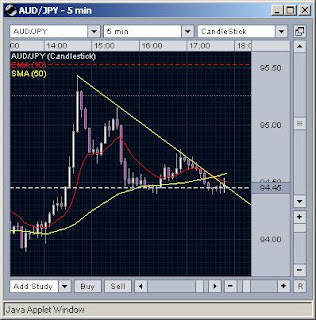
Thursday, December 27, 2007
US Durable Goods / Jobless Claims
The numbers came out weak this morning.
While it appears to have caused some initial softness, I think we should keep in mind that a weak US economy gives the Fed additional room to lower interest rates without fears of inflation.
So, personally, I might consider buying into weakness...
